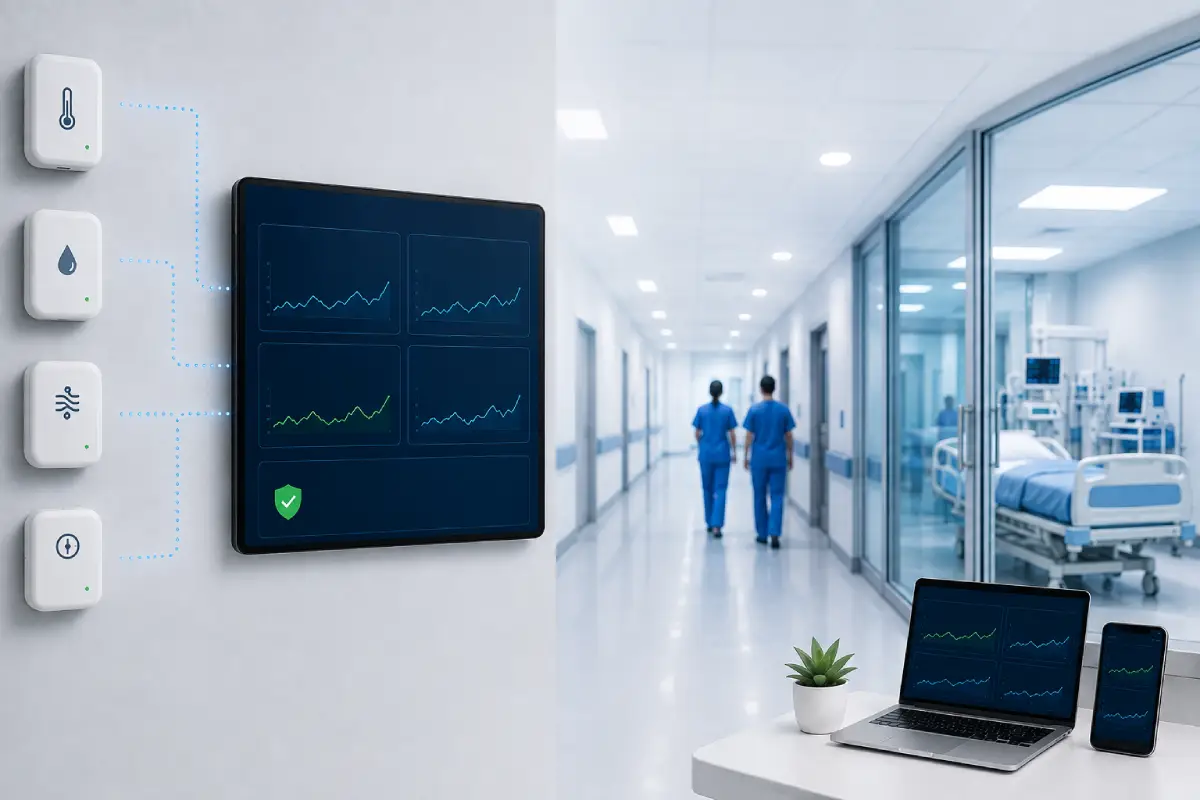
A vaccine refrigerator drifts out of range overnight. An isolation room loses its pressure difference during a shift change. A blood bank refrigerator's compressor trips on a Sunday. None of these is dramatic in the moment, but each can put patients at risk, waste costly medicines and blood, and become a finding at the next accreditation visit.
Manual rounds with a clipboard can't catch a problem at 2 a.m. Continuous monitoring with IoT sensors can. This guide covers what to monitor in a hospital, how alerts and records should work, and what to ask before buying a system.
Why "real-time" matters
Traditional checks happen a few times a day. The gaps between them are where problems hide. A refrigeration failure just after the evening check may go unnoticed until morning. Sensors that report every few minutes, and alert the right person immediately, turn that into a problem fixed within the hour, with a record showing exactly what happened.
What to monitor, space by space
| Space | What to monitor | Why |
|---|---|---|
| Vaccine and medicine refrigerators | Temperature (most vaccines and many medicines are kept at +2 °C to +8 °C, as their labels specify), door open, power | Temperature excursions can make vaccines and medicines ineffective |
| Blood bank | Temperature by component: red cells and whole blood at +2 °C to +6 °C; platelets at +20 °C to +24 °C with agitation; frozen plasma in freezers | Storage ranges are strict and set by blood-safety standards |
| Pharmacy and drug stores | Temperature and humidity | Product labels set storage conditions |
| Operating theatres | Temperature, humidity, room pressure relative to corridors, air changes (from the ventilation system) | Comfort, infection control, equipment performance |
| Isolation rooms | Pressure difference (negative for airborne infection isolation, positive for protective isolation), door status | Pressure keeps airborne pathogens contained, or out |
| ICUs and wards | Temperature, humidity, CO₂ or air quality | Patient comfort and safety |
| Labs and sample storage | Temperature (fridges, freezers, incubators) | Sample integrity |
| Medical gas and utility rooms | Pressure, power, temperature | Early warning of supply problems |
| Server and equipment rooms | Temperature, humidity, water leak | Protects clinical systems |
Targets for each space should come from your infection-control committee, the equipment makers, product labels and the standards your hospital follows. A monitoring system enforces them. It doesn't set them.
Accreditation and records
Indian hospitals accredited by NABH (National Accreditation Board for Hospitals & Healthcare Providers) are assessed on facility management, safety and infection control, and assessors look for evidence that critical conditions were monitored and acted on. Continuous monitoring produces that evidence automatically:
- Every reading timestamped and stored, without manual transcription.
- Every alarm recorded with who acknowledged it, when, and what they did.
- Monthly reports per space, ready for quality reviews and assessments.
A monitoring system supports compliance. Your procedures, training and response to alarms still decide the outcome.
Alerts that work in a hospital
- Route by space and time: pharmacy alerts to the pharmacist on duty, blood bank alerts to the blood bank technician, building alerts to the engineering desk.
- Escalate: if nobody acknowledges within a set time, alert the next person.
- Use a short delay to ignore normal door openings, but never long enough to hide a failure.
- Ask for a reason when acknowledging ("door left open", "defrost", "compressor fault").
- Alert on power loss and sensor offline, not just on temperature.
Installation without disruption
Wireless sensors can usually be fitted in minutes per location, without construction, dust or noise, which matters in wards and theatres that can't close. Mains-powered Wi-Fi sensors suit fridges near power points. Long-range, low-power radios (such as LoRa) suit large campuses with many sensors. (See choosing connectivity for monitoring.)
What to look for in a system
- Several kinds of sensor on one platform: temperature, humidity, pressure, door, power.
- Instant alerts with escalation and acknowledgement reasons.
- Readings that can't be edited, with a full audit trail.
- Calibration certificates for sensors, and a recalibration service.
- Offline buffering, so no gap appears in the record if Wi-Fi drops.
- Integration with building management and maintenance systems.
- Room to grow: from one department to the whole hospital, or several hospitals.
(For storage-specific advice, see our cold-storage temperature monitoring guide.)
Frequently asked questions
What is hospital environmental monitoring?
Continuous tracking of temperature, humidity, pressure and other conditions in critical hospital spaces (fridges, blood banks, theatres, isolation rooms), with alerts and automatic records.
What temperature should a vaccine refrigerator be?
Most vaccines are stored at +2 °C to +8 °C, but always follow the product label and your national immunisation guidelines.
Can monitoring help with NABH accreditation?
It provides continuous, tamper-proof records and alarm logs that show conditions were monitored and acted on. Accreditation also depends on your procedures and how staff respond.
Do we need to rewire the hospital?
Usually not. Wireless sensors fit on fridges, walls and equipment, and connect over Wi-Fi or a low-power radio network.
How often should sensors be calibrated?
Follow the manufacturer's recommendation and your quality system. Many hospitals recalibrate critical sensors once a year.
Still relying on manual rounds for critical spaces? We'll help you map what to monitor and run a pilot in one department. Talk to us →