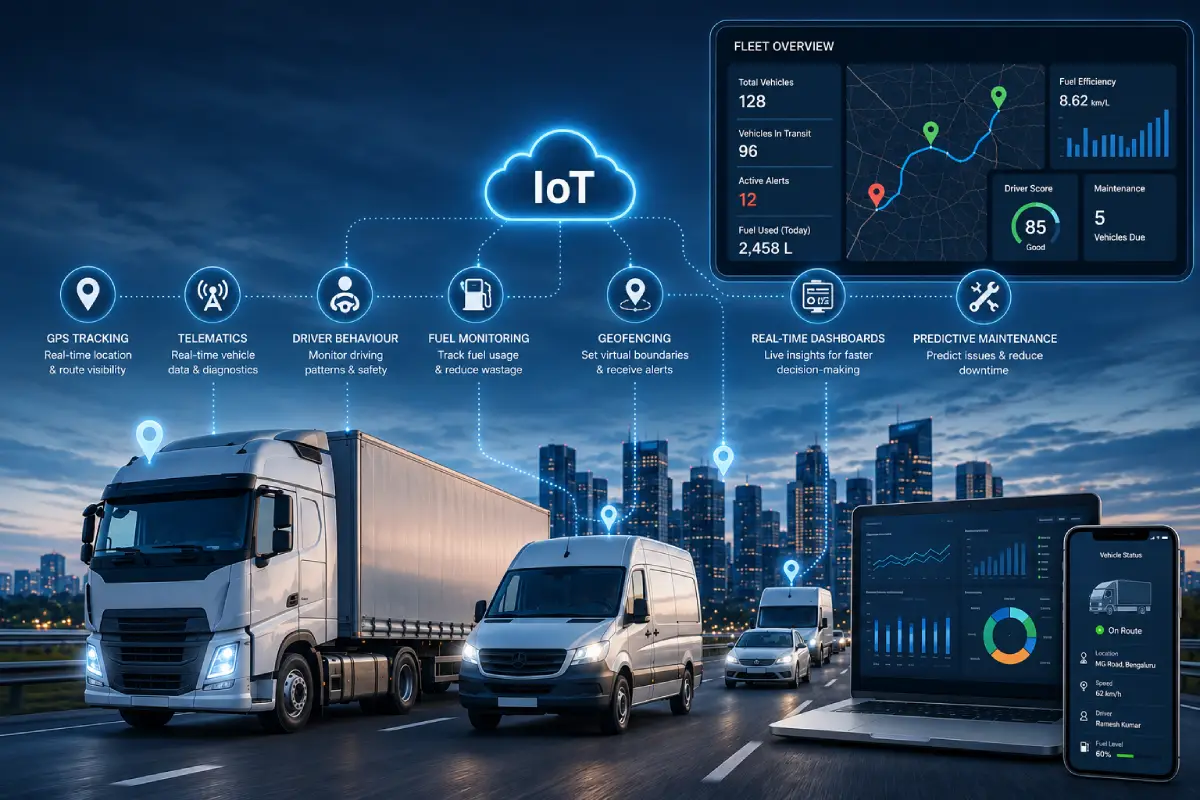
Fleet operations used to run on a dispatcher's memory, drivers' phone calls and a paper logbook in the cabin. Today, a small device in each vehicle can report where it is, how it's being driven, how much fuel it's using, the engine's health and, for refrigerated trucks, the temperature of the load, every minute.
That shift isn't just for large carriers. Manufacturers running their own delivery fleets, distributors, cold-chain operators and bus operators all use it. This guide covers what IoT fleet management does, what's changing, the Indian rules to know, and how to start without overcomplicating it.
What is IoT fleet management?
Vehicles, trailers and equipment carry telematics devices that stream data (location, speed, ignition, engine data, fuel level, door status, cargo temperature) to a central platform. Managers and customers see live status, and the system raises alerts and reports automatically.
What it does for a fleet
| Problem | What IoT data shows | Typical action |
|---|---|---|
| Fuel loss | Fuel level drops while parked, mileage worse than expected, long idling | Investigate drops, coach drivers, cut idling |
| Breakdowns | Engine warning codes, battery voltage, coolant temperature | Service before failure |
| Late deliveries | Live location, stops, route deviation | Re-plan, update customers with real arrival times |
| Unsafe driving | Harsh braking, speeding, night driving | Driver coaching, safety scores |
| Cargo damage (cold chain) | Load temperature, door openings | Alert the driver and dispatcher at once |
| Idle vehicles | Utilisation by vehicle | Right-size the fleet |
Five things changing in 2026
- Maintenance is becoming predictive. Engine and battery data flag likely problems before a roadside breakdown, so workshops schedule repairs instead of reacting. (See predictive maintenance using IoT.)
- AI is moving from dashboards to recommendations: suggesting re-routes, flagging unusual fuel patterns, and ranking which vehicles need attention today. A person still decides.
- Electric vehicles bring new data: battery health, charging sessions and range, alongside the usual metrics.
- Connectivity matters more: vehicles on rural and highway routes cross weak-signal areas. Devices must store data and send it later. (See choosing connectivity.)
- Platforms are consolidating: tracking, maintenance, fuel, driver safety and customer updates on one system, connected to the ERP or transport management system.
Indian rules to know
- AIS-140 for public service vehicles. Rule 125H of the Central Motor Vehicles Rules (inserted by notification GSR 1095(E), 28 November 2016) requires public service vehicles to carry a vehicle location tracking device and emergency buttons meeting the AIS-140 standard. States enforce it through permits and fitness checks, and the Supreme Court has directed strict enforcement. If you run buses, cabs or other public service vehicles, check that devices are AIS-140 approved.
- Food in transit. FSSAI's October 2026 advisory requires temperature control across the supply chain for perishables such as paneer, meat and fish, including transport. Refrigerated vehicles need continuous temperature records. (See our cold-chain monitoring guide.)
Cold-chain trucks: a special case
For refrigerated vehicles, location isn't enough. You need the load temperature, door openings and reefer unit status, recorded continuously, tied to location and time. When a customer rejects a load, that record shows exactly where and when an excursion happened, and whether the door was opened.
Choosing a fleet system
| Question | Good answer |
|---|---|
| What does the device measure? | Location plus the data you need: fuel, engine, temperature, doors |
| What happens with no signal? | Data is stored and uploaded later, with correct timestamps |
| Is fuel data reliable? | A calibrated fuel sensor, not just estimates from GPS distance |
| Is it AIS-140 approved (if required)? | Show the approval certificate |
| Does it connect to our ERP or TMS? | Yes, through an API |
| What does it cost per vehicle per month? | Device, SIM, platform and support, quoted separately |
| Who owns the data? | You do |
The business impact
- Lower running costs: less fuel loss and idling, maintenance before failure.
- Fewer incidents: safer driving through alerts and coaching.
- Better use of vehicles: knowing which vehicles are busy and which sit idle.
- Simpler compliance: automatic records for AIS-140 and cold chain.
- Happier customers: real arrival times and proof of delivery conditions.
Getting started without overcomplicating it
- Pick the problem worth solving first: fuel loss, breakdowns, late deliveries or cold-chain claims.
- Pilot on 10–20 vehicles for 60–90 days, with a measured baseline.
- Choose a platform that connects to your existing systems rather than replacing them.
- Standardise installation and device setup, so scaling to the whole fleet is smooth.
- Treat data security seriously: unique device credentials and controlled access.
Frequently asked questions
What is IoT fleet management?
Using connected devices in vehicles to track location, driving, fuel, engine health and cargo conditions in real time, with alerts and reports for managers and customers.
Is AIS-140 mandatory for our trucks?
Rule 125H applies to public service vehicles. Goods vehicles may be covered by state rules or permit conditions. Check with your state transport department.
Can IoT detect fuel theft?
A calibrated fuel-level sensor can detect sudden drops while a vehicle is parked, and patterns that don't match distance travelled. It's evidence to investigate, not proof on its own.
How much does fleet tracking cost?
It depends on what each device measures (location only, or fuel, engine and temperature too), the SIM plan and the platform. Ask for a per-vehicle monthly cost over three years.
Can we track refrigerated vehicles' temperature?
Yes. Temperature probes and door sensors in the load area report alongside location, with alerts on any excursion.
Want to see a fleet move live? Our logistics demo shows trucks on live routes with geofences and cold-chain data. Run the logistics demo → · Talk to us about a fleet pilot →