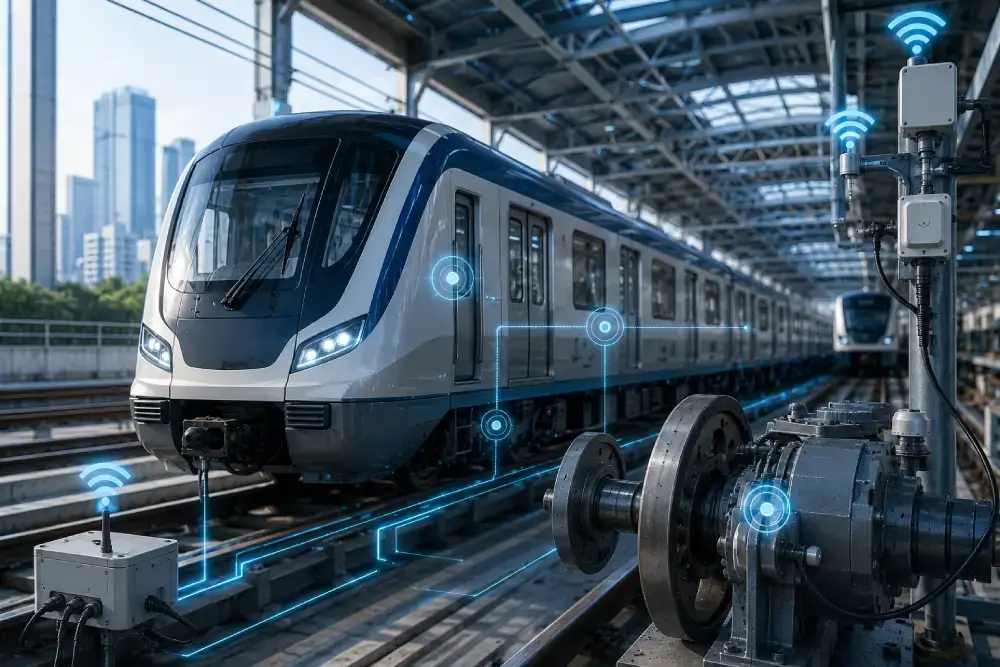
A metro service runs to a timetable measured in minutes. A door fault at a busy station, or a train withdrawn because of a bogie problem, ripples across the whole line. Most maintenance is still scheduled by time or distance, which means some parts are replaced too early and some still fail between inspections.
Predictive maintenance uses sensor data from trains, track and stations to spot problems early, so maintenance happens when the condition says it's needed. The principles are the same as in factories (see our predictive maintenance guide). This page covers what's different about rail.
What to monitor on a metro system
| Subsystem | Signals | Typical faults caught early |
|---|---|---|
| Wheels and bogies | Vibration, wheel-impact readings, bearing temperature | Wheel flats, bearing wear, suspension problems |
| Doors | Opening and closing times, motor current, obstruction events, cycle counts | Slow or sticking doors (a frequent cause of delays) |
| Traction motors and gearboxes | Current, temperature, vibration | Overheating, bearing and gear wear |
| Brakes | Pressure, response time, pad wear indicators | Slow response, leaks, uneven wear |
| HVAC | Temperatures, compressor current, filter pressure drop | Failing compressors, blocked filters |
| Pantograph and power collection | Contact force, arcing events | Wear on the pantograph or overhead line |
| Batteries and auxiliary power | Voltage, temperature, charge cycles | Failing batteries before they leave a train dead |
| Track | Vibration from trains or wayside sensors, geometry data | Rail wear, track irregularities |
| Station equipment | Escalator and lift motor current and vibration, platform screen door cycles | Breakdowns of high-use station assets |
How it works
- On-train and wayside sensors, plus data the train already records (many modern trains log faults and events in their onboard systems).
- Data transfer, live over cellular or in bulk when the train is in the depot.
- Analysis: anomaly detection first (what's unusual for this train or door?), then models for specific faults as failure history builds up.
- Maintenance planning: alerts become depot work orders, scheduled into the train's next stabling window rather than taking it out of service.
Start with one subsystem
Rail fleets are large and complex. Start where failures are frequent, delays are costly and the signals are clear:
| Good first choices | Why |
|---|---|
| Doors | Frequent faults, big effect on punctuality, clear signals (timing, current) |
| HVAC | Passenger comfort complaints, clear signals, low safety risk |
| Station escalators and lifts | High use, easy to instrument, independent of rolling stock |
Prove value on one subsystem for a few months, then extend.
Safety-critical systems: monitoring advises, it doesn't decide
Brakes, signalling and train control are safety-critical and governed by strict railway safety processes and standards. IoT monitoring can give engineers earlier warning of degradation, but it doesn't replace the certified protection systems or the safety case. Any change to how a safety-critical system is maintained should go through the operator's normal safety approval.
What it delivers
- Fewer in-service failures and train withdrawals.
- Maintenance planned into stabling windows, not emergency call-outs.
- Fewer unnecessary part replacements, based on condition rather than fixed intervals.
- Better use of depot staff and spares.
Challenges to plan for
| Challenge | How to handle it |
|---|---|
| Access to onboard train data | Agree access with the train manufacturer early. It's often in the maintenance contract |
| Connectivity in tunnels | Store on the train and upload in stations or at the depot |
| Mixed fleets (several train types) | Common data model, with one adapter per train type |
| Cybersecurity | Keep monitoring separate from train control networks. Read-only access |
| Maintenance culture | Involve depot teams in setting thresholds, and log the outcome of every alert |
Frequently asked questions
What is predictive maintenance in railways?
Using sensor and onboard data to predict when train, track or station components will need maintenance, so work happens before a failure and at a convenient time.
Which metro subsystems benefit most?
Doors, HVAC, traction motors, bogies and wheels, and station escalators and lifts are common starting points.
Can it work with older trains?
Yes. Add-on sensors (vibration, temperature, current) can be fitted where onboard data isn't available, subject to the operator's approval processes.
Does it replace scheduled maintenance?
Not entirely. Safety inspections and statutory maintenance continue. Predictive maintenance adjusts the rest based on actual condition.
Working on rolling stock or station asset maintenance? We'll help you pick a first subsystem and run a pilot. Talk to our IoT engineers →